

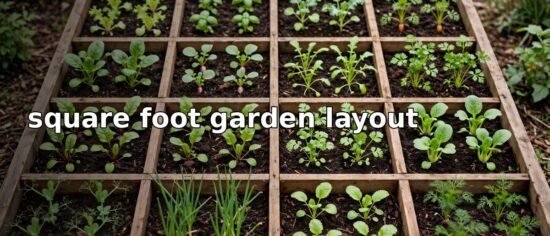
A square foot garden layout divides a raised bed into one-foot squares, so every plant gets exactly the space it needs and nothing is wasted. Plan each square by the plant’s spacing needs, group tall crops on the north side, and rotate crops each season, so a small bed grows far more food than a row garden of the same size.
Key Takeaways
- Divide each raised bed into one-foot squares with a simple grid.
- Plant by spacing needs: one large plant, four medium plants, nine small plants or sixteen tiny plants per square.
- Put tall crops on the north side so they never shade short ones.
- Rotate crop families each season to keep the soil healthy.
- A 4 by 4 foot bed with 16 squares can feed a small household through summer.
Why Does a Square Foot Layout Work So Well?
A traditional row garden wastes most of its space on paths. Wide rows of one crop leave bare soil between them, and that bare soil grows weeds, dries out fast and produces nothing. A square foot garden flips that idea: the bed is the garden, the paths are outside it, and every square foot is planted.
The grid is what makes it work. When a bed is divided into one-foot squares, you stop guessing how far apart to plant things. Each square holds a fixed number of plants based on their size, so the bed fills evenly and the plants shade the soil between them, which keeps moisture in and weeds down. For wider garden ideas, Decoration Tips Decoradhouse from Decoratoradvice is a useful place to start.
How Do You Plan the Grid?
Start with the bed size. A 4 by 4 foot bed is the classic square foot size, because you can reach the middle square from any side without stepping on the soil. Longer beds work too, but keep them no wider than 4 feet, or the middle squares become hard to reach.
Mark the grid with string, thin wooden strips or twine tied across the bed. The grid is not decoration: it is the plan.
| Bed size | Number of squares | Best for |
|---|---|---|
| 4 by 4 feet | 16 | One household’s salads and herbs |
| 4 by 8 feet | 32 | A family’s main summer vegetables |
| 2 by 4 feet | 8 | A balcony or small patio |
| 3 by 3 feet | 9 | A child’s first garden |
How Many Plants Go in Each Square?
Spacing is the heart of the method. Large plants such as tomatoes, peppers and broccoli need a whole square each. Medium plants such as lettuce, chard and bush beans fit four to a square. Small plants such as carrots, radishes and onions fit nine or sixteen, depending on the variety.
The rule is simple: take the spacing the seed packet gives, and work out how many fit in twelve inches. A plant that needs six inches of space fits four per square. One that needs three inches fits sixteen. Planting by this rule means no thinning later, because every seed has room from the start.
How Do You Arrange Tall and Short Crops?
Tall crops must go on the north side of the bed, so their shade falls outside the bed instead of across it. In the northern hemisphere, the sun moves across the south, so a tall plant on the south side shades everything behind it. Put tomatoes, pole beans and sweetcorn along the north edge, and keep the south edge for low crops such as lettuce, carrots and herbs.
Plan height before you plant, not after. A sketch with tall crops marked at the back and short crops at the front takes a minute and stops the most common square foot mistake. For more advice on planning what to grow, garden tips decoradhouse is worth a look.
Arrange the bed in this order:
- Mark the north side of the bed and reserve it for tall crops.
- Place the trellis along the north edge before planting anything.
- Fill the back squares with tomatoes, beans and other tall plants.
- Fill the middle squares with medium crops such as lettuce and peppers.
- Fill the front squares with low crops such as carrots, radishes and herbs.
How Do You Rotate Crops in a Square Foot Bed?
Crop rotation matters even in a small bed. Growing tomatoes in the same square year after year builds up soil problems, and the plants get weaker each season. The fix is to move crop families around the bed each year, so no family returns to the same square for three years.
Group crops by family: tomatoes, peppers and potatoes are one family; beans and peas are another; carrots, parsnips and celery are a third; cabbages, broccoli and kale are a fourth. Each season, shift each family to a new set of squares. For clever ways to get more from a small garden, garden hacks decoradhouse is worth a look.
Keep a simple record. A notebook or a photo of the paper plan, with the year written on it, is enough. Without a record, rotation is guesswork, and the same square will end up holding tomatoes three years running.
What Soil and Watering Does the Layout Need?
Square foot beds need loose, rich soil, because plants grow closer together than in a row garden and share the same small patch of earth. A mix of topsoil, compost and a drainage material works well, and the bed should be topped up with compost each spring, since close planting eats through nutrients fast.
Water the squares, not the paths. A watering can with a fine rose, or a drip line along the bed, puts water where the roots are. Overhead sprinklers waste water on paths and wet the leaves, which invites disease in closely planted beds. For more garden planning ideas, decoradhouse garden tips by decoratoradvice can help you plan the work.
| Bed care task | How often | Why it matters |
|---|---|---|
| Top up with compost | Every spring | Close planting uses nutrients fast |
| Water at the roots | When the top 3 cm is dry | Keeps leaves dry and roots fed |
| Mulch the squares | After planting | Holds moisture, stops weeds |
| Check the grid | Each season | Keeps the plan visible and useful |
What Are the Exceptions and Edge Cases?
- Very small beds: In a 2 by 2 foot bed, skip tall crops entirely and grow salads and herbs only, so nothing shades the rest.
- Shady gardens: If the bed gets less than six hours of sun, grow leafy greens and herbs, and skip fruiting crops such as tomatoes, which need full sun.
- Root vegetables: Carrots and parsnips need deep, stone-free soil, so use the deepest bed you have and sieve the mix for their squares.
- Climbing crops: Pole beans and cucumbers need a trellis on the north side, and the squares below the trellis suit shade-tolerant lettuce.
Frequently Asked Questions
How big should a square foot garden bed be?
Four feet by four feet is the classic size, with sixteen squares. It is wide enough to grow a useful amount of food and narrow enough to reach the middle from any side.
How many plants fit in one square foot?
It depends on the plant’s size: one large plant such as a tomato, four medium plants such as lettuce, nine small plants such as carrots, or sixteen tiny plants such as radishes.
Do I need a trellis in a square foot garden?
Only for climbing crops such as pole beans and cucumbers. Put the trellis on the north side, so it does not shade the rest of the bed.
Can I grow root vegetables in a square foot bed?
Yes, if the bed is deep enough and the soil is loose and stone-free. Carrots and parsnips need at least 30 cm of soil to grow straight.
How do I stop the squares getting crowded?
Follow the spacing rule and plant one crop per square. Overplanting is the most common mistake, and it is fixed by thinning early or replanting to the right count.
Should I rotate crops in such a small bed?
Yes. Move crop families to different squares each year, so no family returns to the same square for three years. A paper plan with the year on it is enough to track it.
Conclusion
A square foot garden layout turns a small raised bed into a serious vegetable garden: a simple grid, one crop per square, tall plants on the north side and a fresh crop in every square as soon as the last one finishes. Plan on paper first, plant by spacing, rotate each season, and the bed will feed you far beyond its size. With that method, this square foot garden layout will grow more food in less space than any row garden of the same size.